Have you ever heard of Julian Simon?
He died a few years ago - a great loss to anyone who cares about truth and the environment. Simon made a career out of proving the environmental doomsayers wrong with provable empirical data.
I first heard of him through an article in Wired Magazine back in 1977. The article is as relevant today as it was then - in fact more so, because of the recent near-hysteria of global warming alarmism.
Go read it. I guarantee it will change how you view things.
Friday, January 05, 2007


Becky Johnson - one of a kind
Becky Johnson died this week at the age of 93. She was one of the most extraordinary people I have ever met. I only wish I had the chance to know her better. As it happened, I never met her in person, but had several extensive phone conversations with her.
One day I was working in my office, and my phone rang. "Rob, this is Becky Johnson," a very firm, but clearly elderly voice informed me. She explained that she was a trustee at Lewis & Clark College, and she wanted to talk to me about my recent column in BrainstormNW Magazine in which I took to task the dean of Lewis & Clark's graduate school of education.
I first thought "Uh-oh, she's gunna let me have it," but she went on to explain that she had been complaining for years about precisely the same thing I wrote about. She had already taken my column, copied it, and distributed it to the other trustees and the management of the college.
We were on the phone for at least an hour and a half in that first conversation. We talked about education, the environment, local politics, the legislature and a bunch of other topics. It was incredible how much she knew about what was going on and how clear her thinking was - but what intrigued me most was the combination of her extensive knowledge coupled with her 90+ years of experience. It gave her a perspective on things more sophisticated than I can relate.
She was clearly a highly intelligent woman, and was blessed with a huge surplus of common sense. Her mind was incredibly sharp, even in her 90's.
Becky is the mother of State Senator Betsy Johnson, and it is easy to see where Betsy's common sense came from.
The world needs more Becky Johnsons. I wish I knew her better, but I am thankful for the time I did have to get to know her.
One day I was working in my office, and my phone rang. "Rob, this is Becky Johnson," a very firm, but clearly elderly voice informed me. She explained that she was a trustee at Lewis & Clark College, and she wanted to talk to me about my recent column in BrainstormNW Magazine in which I took to task the dean of Lewis & Clark's graduate school of education.
I first thought "Uh-oh, she's gunna let me have it," but she went on to explain that she had been complaining for years about precisely the same thing I wrote about. She had already taken my column, copied it, and distributed it to the other trustees and the management of the college.
We were on the phone for at least an hour and a half in that first conversation. We talked about education, the environment, local politics, the legislature and a bunch of other topics. It was incredible how much she knew about what was going on and how clear her thinking was - but what intrigued me most was the combination of her extensive knowledge coupled with her 90+ years of experience. It gave her a perspective on things more sophisticated than I can relate.
She was clearly a highly intelligent woman, and was blessed with a huge surplus of common sense. Her mind was incredibly sharp, even in her 90's.
Becky is the mother of State Senator Betsy Johnson, and it is easy to see where Betsy's common sense came from.
The world needs more Becky Johnsons. I wish I knew her better, but I am thankful for the time I did have to get to know her.
All day kindergarten, lower class size or fully fund Head Start?
There's a tussle afoot over how to spend some of the new K-12 money in the governor's budget.
State Superintendent Susan Castillo wants to fund all-day kindergarten, whereas currently the state only provides funds for half days. The governor wants to make Head Start available for every child who qualifies, whereas now about 60% of the qualified kids have spots in Head Start programs. And Project Chalkboard wants to decrease class sizes in kindergarten and first grade classrooms to 15 students per class, whereas now the number (on average - it varies widely) is about 21 students per class.
Each, of course, comes with its own price tag. So what is the best use of tax dollars? Available research barely clarifies things.
The effects of Head Start programs have been studied time and again. The convergence of the research would suggest that kids in HS programs do indeed enter school with an advantage over their peers, but that advantage disappears after about grade three. The best summary of the research I have found was in Abigail Thernstrom's "No Excuses - Eliminating the Achievement Gap in Education."
There is simply not much good research on the benefits of all day kindergarten.
Class size, like Head Start, has been studied time and again. The quick bottom line: lowering class size has very little effect except at the early elementary level, and then only if the class size is reduced to the 14-15 students per class, where a small but statistically significant gain in achievement made.
So given these three choices, what is the best direction? I'll give a thumbnail analysis that handicaps each:
Head Start: The fact that gains from Head Start participation disappears after a few years is probably less a knock on Head Start programs than it is the schools that Head Start students tend to attend after leaving Head Start. By definition, Head Start is primarily in low income areas where the elementary schools are far more likely to be bad. It could very well be the case that Head Start is generally doing its job very effectively, only to have the elementary schools screwing it up. But if that is the case, wouldn't our efforts and money be better spent reforming the elementary schools, rather than spending more on Head Start?
All-day kindergarten: This is very popular with parents, because they get a longer break from their little darlings each day. But the educational benefits are suspect at best. The fact is, our kindergartens are mostly play-schools, as currently structured. For the most part, not much in the way of academics is taught in kindergarten. They tend to focus on "readiness" activities.
In the Arthur Academies that I help start, we do indeed have academic kindergartens where we focus on phonics and basic math. Would a full day make us more effective? No - five year olds simply are not equipped to have all-day academics. If the state funded all day kindergarten, we wouldn't probably increase the academic component of our kindergartens at all. (Oh, by the way, our kindergartners are off-the-charts in academic achievement, which calls the question: if we can do that in a half day, why would a full day be required?)
Class size reduction: Class size reduction is the "minimum wage" of education. That is, it is terrific politics, and horrible policy. Like a call for an increase in minimum wage, no politician ever was criticized for calling for smaller class sizes. It sounds compassionate, it threatens no-one, and both parents and the education establishment love it. But it is lousy policy.
As I said, the research shows a discernible increase in achievement only when class size is below 15 students. Project Chalkboard at least should be given credit in that they are calling for reducing the size to that level. But the question is whether this is the best way to get that level of achievement increase - and the answer is emphatically NO. As researcher Eric Hanushek (who did most of his class size research while at the University of Rochester) showed, class size reduction is perhaps the least efficient way to increase achievement. Dollar for dollar, there are far better ways.
The problem is that class size initiatives require hiring a lot of teachers, the quality of which are suspect. Then, there is the problem of facilities. Nobody ever prices in the cost of classrooms when suggesting lower class sizes - they always just calculate the personnel cost.
A seat in an Oregon elementary school these days requires a capital investment of roughly $20,000. Reducing kindergarten and first grade class sizes by a third means about 30,000 new seats - that would cost $600+ million to build anew. Of course, some districts have excess capacity, such as Portland, so they wouldn't have to build. But nearly every other Portland metro area school district already has a shortage of classrooms. Mandating lower class sizes would force them to pass new bonds to build more classrooms - and this cost has not been part of the discussion initiated by Chalkboard.
So, what is the best choice? Frankly, none of them would be on my list of the best ways to improve educational outcomes. We'd get far better early elementary results simply by using effective teaching practices in our elementary schools, such as we do in the Arthur Academies.
But given the three choices, I'd say that the Head Start is the best option. At least it's targeted to the kids who are most in need - and most likely to fail. And it has the added benefit of keeping the dollars out of the education establishment and the teachers union!
This, of course, is the reason why the Head Start option will probably lose. The unions will get their way, and from their perspective, they like both lower class sizes AND all day kindergarten, because they both result in more dues paying members.
State Superintendent Susan Castillo wants to fund all-day kindergarten, whereas currently the state only provides funds for half days. The governor wants to make Head Start available for every child who qualifies, whereas now about 60% of the qualified kids have spots in Head Start programs. And Project Chalkboard wants to decrease class sizes in kindergarten and first grade classrooms to 15 students per class, whereas now the number (on average - it varies widely) is about 21 students per class.
Each, of course, comes with its own price tag. So what is the best use of tax dollars? Available research barely clarifies things.
The effects of Head Start programs have been studied time and again. The convergence of the research would suggest that kids in HS programs do indeed enter school with an advantage over their peers, but that advantage disappears after about grade three. The best summary of the research I have found was in Abigail Thernstrom's "No Excuses - Eliminating the Achievement Gap in Education."
There is simply not much good research on the benefits of all day kindergarten.
Class size, like Head Start, has been studied time and again. The quick bottom line: lowering class size has very little effect except at the early elementary level, and then only if the class size is reduced to the 14-15 students per class, where a small but statistically significant gain in achievement made.
So given these three choices, what is the best direction? I'll give a thumbnail analysis that handicaps each:
Head Start: The fact that gains from Head Start participation disappears after a few years is probably less a knock on Head Start programs than it is the schools that Head Start students tend to attend after leaving Head Start. By definition, Head Start is primarily in low income areas where the elementary schools are far more likely to be bad. It could very well be the case that Head Start is generally doing its job very effectively, only to have the elementary schools screwing it up. But if that is the case, wouldn't our efforts and money be better spent reforming the elementary schools, rather than spending more on Head Start?
All-day kindergarten: This is very popular with parents, because they get a longer break from their little darlings each day. But the educational benefits are suspect at best. The fact is, our kindergartens are mostly play-schools, as currently structured. For the most part, not much in the way of academics is taught in kindergarten. They tend to focus on "readiness" activities.
In the Arthur Academies that I help start, we do indeed have academic kindergartens where we focus on phonics and basic math. Would a full day make us more effective? No - five year olds simply are not equipped to have all-day academics. If the state funded all day kindergarten, we wouldn't probably increase the academic component of our kindergartens at all. (Oh, by the way, our kindergartners are off-the-charts in academic achievement, which calls the question: if we can do that in a half day, why would a full day be required?)
Class size reduction: Class size reduction is the "minimum wage" of education. That is, it is terrific politics, and horrible policy. Like a call for an increase in minimum wage, no politician ever was criticized for calling for smaller class sizes. It sounds compassionate, it threatens no-one, and both parents and the education establishment love it. But it is lousy policy.
As I said, the research shows a discernible increase in achievement only when class size is below 15 students. Project Chalkboard at least should be given credit in that they are calling for reducing the size to that level. But the question is whether this is the best way to get that level of achievement increase - and the answer is emphatically NO. As researcher Eric Hanushek (who did most of his class size research while at the University of Rochester) showed, class size reduction is perhaps the least efficient way to increase achievement. Dollar for dollar, there are far better ways.
The problem is that class size initiatives require hiring a lot of teachers, the quality of which are suspect. Then, there is the problem of facilities. Nobody ever prices in the cost of classrooms when suggesting lower class sizes - they always just calculate the personnel cost.
A seat in an Oregon elementary school these days requires a capital investment of roughly $20,000. Reducing kindergarten and first grade class sizes by a third means about 30,000 new seats - that would cost $600+ million to build anew. Of course, some districts have excess capacity, such as Portland, so they wouldn't have to build. But nearly every other Portland metro area school district already has a shortage of classrooms. Mandating lower class sizes would force them to pass new bonds to build more classrooms - and this cost has not been part of the discussion initiated by Chalkboard.
So, what is the best choice? Frankly, none of them would be on my list of the best ways to improve educational outcomes. We'd get far better early elementary results simply by using effective teaching practices in our elementary schools, such as we do in the Arthur Academies.
But given the three choices, I'd say that the Head Start is the best option. At least it's targeted to the kids who are most in need - and most likely to fail. And it has the added benefit of keeping the dollars out of the education establishment and the teachers union!
This, of course, is the reason why the Head Start option will probably lose. The unions will get their way, and from their perspective, they like both lower class sizes AND all day kindergarten, because they both result in more dues paying members.
Thursday, January 04, 2007
Another New Year, another "Business Summit"
I took a couple weeks off at the end of the year, but I'm back to it now. A few things have piled up. First, the recent issue:
Oregon Leadership Summit: Every year, Oregon's pretend business groups (there are three: Oregon Business Council, Oregon Business Alliance, and the Portland Business Association) put on the Oregon Business Summit, where they create a bunch of plans for government programs and call it the "Oregon Business Plan."
Only in Oregon would the business establishment actually go along with this stuff. This year the Summit has on its agenda: 1) More money for K-12; 2) Universal health care; 3) How to "fix" Measure 37, and 4) sustainability.
That's it. All of it is public sector stuff, sold under the guise of a business plan, and validated by the collaborators - the Portland business establishment.
Sustainability will be the overriding theme. From what I hear, all the presentations were to focus on different ways businesses have found to incorporate green/sustainable practices into their operations.
The Oregonian, of course, is all agog about it. They wrote the most nonsensical editorial today talking about how sustainability is Oregon's big competitive advantage, and how much money is to be made by Oregon being a global leader in sustainable business practices. They write:
"The state's top business and government leaders will rally around a new economic strategy of building on and selling Oregon's history and expertise in sustainability."
After all, says the Oregonian, Oregon has already laid the groundwork for this new economic strategy with our: "forest practices rules, land-use planning, solid waste recycling, wetlands protection, greenspace investment, support for light rail and bicycle transportation."
Huh?
So now they are calling these anti-business policies an ecomomic strategy? Forest practice rules that basically euthanized our timber industry? Land use planning that has made Oregon a totally non-competitive state to do business in and has driven up housing costs so far that few middle class families can afford a home? Solid waste recycling madates that waste tremendous resources by forcing the use of more costly recycled materials rather than the plentiful raw materials? Wetlands and greenspace "protection" that force on private property owners the costs of preserving land that supposedly benefits the public? The proven failure of light rail, which has diverted billions away from road capacity improvements and created the fastest increasing congestion in the U.S.?
In the Oregonians' mind, these are all huge opportunities to export our expertise to other states. The world is lining up at our door for us to teach them how we did it, how we achieved the status of near the top in unemployment over the last six years.
And our pathetic business community goes along with it. More later.
Oregon Leadership Summit: Every year, Oregon's pretend business groups (there are three: Oregon Business Council, Oregon Business Alliance, and the Portland Business Association) put on the Oregon Business Summit, where they create a bunch of plans for government programs and call it the "Oregon Business Plan."
Only in Oregon would the business establishment actually go along with this stuff. This year the Summit has on its agenda: 1) More money for K-12; 2) Universal health care; 3) How to "fix" Measure 37, and 4) sustainability.
That's it. All of it is public sector stuff, sold under the guise of a business plan, and validated by the collaborators - the Portland business establishment.
Sustainability will be the overriding theme. From what I hear, all the presentations were to focus on different ways businesses have found to incorporate green/sustainable practices into their operations.
The Oregonian, of course, is all agog about it. They wrote the most nonsensical editorial today talking about how sustainability is Oregon's big competitive advantage, and how much money is to be made by Oregon being a global leader in sustainable business practices. They write:
"The state's top business and government leaders will rally around a new economic strategy of building on and selling Oregon's history and expertise in sustainability."
After all, says the Oregonian, Oregon has already laid the groundwork for this new economic strategy with our: "forest practices rules, land-use planning, solid waste recycling, wetlands protection, greenspace investment, support for light rail and bicycle transportation."
Huh?
So now they are calling these anti-business policies an ecomomic strategy? Forest practice rules that basically euthanized our timber industry? Land use planning that has made Oregon a totally non-competitive state to do business in and has driven up housing costs so far that few middle class families can afford a home? Solid waste recycling madates that waste tremendous resources by forcing the use of more costly recycled materials rather than the plentiful raw materials? Wetlands and greenspace "protection" that force on private property owners the costs of preserving land that supposedly benefits the public? The proven failure of light rail, which has diverted billions away from road capacity improvements and created the fastest increasing congestion in the U.S.?
In the Oregonians' mind, these are all huge opportunities to export our expertise to other states. The world is lining up at our door for us to teach them how we did it, how we achieved the status of near the top in unemployment over the last six years.
And our pathetic business community goes along with it. More later.
Thursday, December 21, 2006
Gender equity runs amok
Here's the story:
An NCAA committee recommends prohibiting the practice of women's basketball teams from scrimmaging against men. They say it is contrary to the spirit of Title IX, and that it "implies an archaic notion of male preeminence that continues to impede progress toward gender equity and inclusion."
In other words, I guess, scrimmaging against men implies that men are better at basketball, which is contrary to what they wish was true. So if they prohibit it, what they wish was true might actually come true.
What a bunch of nonsense. Women basketball coaches, of course, want to keep scrimmaging against men. It seems they are more worried about developing their players than about some feminist political agenda.
An NCAA committee recommends prohibiting the practice of women's basketball teams from scrimmaging against men. They say it is contrary to the spirit of Title IX, and that it "implies an archaic notion of male preeminence that continues to impede progress toward gender equity and inclusion."
In other words, I guess, scrimmaging against men implies that men are better at basketball, which is contrary to what they wish was true. So if they prohibit it, what they wish was true might actually come true.
What a bunch of nonsense. Women basketball coaches, of course, want to keep scrimmaging against men. It seems they are more worried about developing their players than about some feminist political agenda.
Let me get this straight...
So a bike nazi was demonstrating during one of the Critical Mass rides, standing on the sidewalk next to his bike, when a police officer told him to move along. He refused, and the policeman gave him a ticket for impeding traffic and for failing to obey a police officer.
The bike nazi goes to court, and argues that the impeding traffic charge cannot apply because the law applies to "people driving cars and riding bikes." Since he wasn't riding his bike at the time, he argued that he couldn't be in violation of the law.
Attorney General Hardy Meyers conceded the point, and the Court of Appeals dismissed the ticket!
So let me get this straight.... by this reasoning I could drive my car into an intersection, get out of the car and stand on the sidewalk, and I couldn't be charged with impeding traffic? After all, I wouldn't be "driving."
On second thought, if I did do this, they'd probably give me a reward rather than a ticket. After all, I'd be advancing their agenda of creating as much congestion as possible.
The bike nazi goes to court, and argues that the impeding traffic charge cannot apply because the law applies to "people driving cars and riding bikes." Since he wasn't riding his bike at the time, he argued that he couldn't be in violation of the law.
Attorney General Hardy Meyers conceded the point, and the Court of Appeals dismissed the ticket!
So let me get this straight.... by this reasoning I could drive my car into an intersection, get out of the car and stand on the sidewalk, and I couldn't be charged with impeding traffic? After all, I wouldn't be "driving."
On second thought, if I did do this, they'd probably give me a reward rather than a ticket. After all, I'd be advancing their agenda of creating as much congestion as possible.
Wednesday, December 20, 2006
Anti Union Unions
This reported today on WSJ's OpinonJournal.com:
With a decision expected any day on where the Democratic Party will hold its 2008 national convention, a union leader in Denver has refused to sign a no-strike pledge, a move one organizer called a possible deal-breaker," reports Denver's KMGH-TV:
Jim Taylor, head of the Local No. 7 International Alliance of Theatrical Stage Employees, is refusing to sign the agreement pledging not to strike if the convention comes to Denver, labor officials told The Denver Post. . . .
Debbie Willhite, executive director of Denver's host committee, told the Post that a lack of full union support for the city's bid is "probably a deal-breaker" for the Democratic National Committee.
Apparently the Democrats are for organized labor, except when it inconveniences them.
With a decision expected any day on where the Democratic Party will hold its 2008 national convention, a union leader in Denver has refused to sign a no-strike pledge, a move one organizer called a possible deal-breaker," reports Denver's KMGH-TV:
Jim Taylor, head of the Local No. 7 International Alliance of Theatrical Stage Employees, is refusing to sign the agreement pledging not to strike if the convention comes to Denver, labor officials told The Denver Post. . . .
Debbie Willhite, executive director of Denver's host committee, told the Post that a lack of full union support for the city's bid is "probably a deal-breaker" for the Democratic National Committee.
Apparently the Democrats are for organized labor, except when it inconveniences them.
Tuesday, December 19, 2006
Study shows climate goes through 1500 year cycles
A new study of geologic evidence concluded that the earth's climate goes through consistent 1500 year warming/cooling cycles within the known 90,000 year ice-age cycles.
The upshot is that our current warming is simply due to being on the upslope of a 1500 year cycle, and is nothing out of the ordinary compared to global temperatures in the past. The current warming started about 1850, after a global cooling that ranged from about 1300 - 1850. Prior to 1300 the earth was in a "medieval warm period."
The study looked at data gleaned from all sorts of temperature proxies - ice cores, lake bed sediment, stalagmites, pollen data, and others.
The study was done by Dr. Fred Singer, a known global warming skeptic. He is a fellow at the National Center for Policy Analysis. Now, I am certain that global warming believers will point out that NCPA and Dr. Singer have received money from energy companies for their research projects, and so their research is tainted and should be dismissed.
OK, fine. Then of course we should dismiss any research paid for by federal government grants, too, right? After all, the official position of all the federal agencies that fund such research is that global warming is a huge problem. Researchers whose results prove otherwise might be kicked off the grant gravy train.
Actually, the data should stand on its own. Argue the data, not who brought it to the discussion. Read this study and ask if the case it makes isn't pretty compelling.
Hat tip to Andy for sending me the link to the study.
The upshot is that our current warming is simply due to being on the upslope of a 1500 year cycle, and is nothing out of the ordinary compared to global temperatures in the past. The current warming started about 1850, after a global cooling that ranged from about 1300 - 1850. Prior to 1300 the earth was in a "medieval warm period."
The study looked at data gleaned from all sorts of temperature proxies - ice cores, lake bed sediment, stalagmites, pollen data, and others.
The study was done by Dr. Fred Singer, a known global warming skeptic. He is a fellow at the National Center for Policy Analysis. Now, I am certain that global warming believers will point out that NCPA and Dr. Singer have received money from energy companies for their research projects, and so their research is tainted and should be dismissed.
OK, fine. Then of course we should dismiss any research paid for by federal government grants, too, right? After all, the official position of all the federal agencies that fund such research is that global warming is a huge problem. Researchers whose results prove otherwise might be kicked off the grant gravy train.
Actually, the data should stand on its own. Argue the data, not who brought it to the discussion. Read this study and ask if the case it makes isn't pretty compelling.
Hat tip to Andy for sending me the link to the study.
Monday, December 18, 2006
Rex explains himself
In today's Oregonian, Rex Burkholder tries to back away from his now famous statement that "every penny spent on transportation is wasted." He apologizes if he "offended" any "transportation engineers, planners and construction crews or my fellow policy-makers and transportation advocates."
The problem wasn't that anyone was offended, Rex. The problem with what you said is that it reveals you to be an extremist.
Your explanation of what you really meant actually makes it worse. Your explanation is incoherent, and simply shows that you want to use land use and transportation policy for social engineering.
You say that what you meant to point out by your statement was that transportation was expensive, and that it is a "cost to avoid or minimize." That doesn't help much, Rex. In fact, it says pretty much the same thing - you don't want to spend money on transportation. You want to spend as little as possible, presumably because you think it is a waste of money.
However, to be charitable, perhaps what you meant was that you want transportation spending to minimize the cost per passenger mile of moving people. That is something I would totally support. Resources are scarce, and we should choose transportation investments that give us maximum value - those that are most efficient in terms of cost per passenger mile.
But although you try to pretend you care about efficiency, if you actually did, you would never support light rail. It is the most expensive and least efficient method of moving people we have tried. So your actions show that you don't care about minimizing the cost per passenger mile - you want to minimize how much we spend on transportation, period.
Which is exactly what you said before.
The problem wasn't that anyone was offended, Rex. The problem with what you said is that it reveals you to be an extremist.
Your explanation of what you really meant actually makes it worse. Your explanation is incoherent, and simply shows that you want to use land use and transportation policy for social engineering.
You say that what you meant to point out by your statement was that transportation was expensive, and that it is a "cost to avoid or minimize." That doesn't help much, Rex. In fact, it says pretty much the same thing - you don't want to spend money on transportation. You want to spend as little as possible, presumably because you think it is a waste of money.
However, to be charitable, perhaps what you meant was that you want transportation spending to minimize the cost per passenger mile of moving people. That is something I would totally support. Resources are scarce, and we should choose transportation investments that give us maximum value - those that are most efficient in terms of cost per passenger mile.
But although you try to pretend you care about efficiency, if you actually did, you would never support light rail. It is the most expensive and least efficient method of moving people we have tried. So your actions show that you don't care about minimizing the cost per passenger mile - you want to minimize how much we spend on transportation, period.
Which is exactly what you said before.
Wednesday, December 13, 2006
On the bleeding edge again
Why does Oregon always have to be the first state to try out major social reforms that are touted as "models for the nation," but somehow never end up being copied (and almost always end up failing.)
I'm sorry, but our politicians are not smarter than those in every other state. But they certainly do have a much higher level of hubris. Time and again they have decided they know how to restructure major institutions, and again and again they have fallen flat.
But they are up to it again. Comprehensive health care is coming to Oregon. A Senate commission co-chaired by the state's newest Democrat Ben Westlund has released its recommendation (to the plaudits of the Oregonian, of course who has cheerleaded every one of Oregon's failed experiments) for a universal health care system.
The Oregonian said Westlund's commission "took a giant step forward by endorsing the general shape of a first-in-the-nation plan for universal health care."
Now, says Westlund, "All eyes are once again on Oregon."
Yes, that is probably right. I'm sure they are all watching to figure out just what NOT to do, just like when precisely zero states copied CIM and CAM, or our land use planning system, or Oregon's first attempt at Kitzhaber-care.
What is the huge innovation that came out of the committee? Well, the details are vague. In fact, there are no details. "Virtually all the details have yet to be worked out..." the Oregonian tells us.
Huh? Just what did the Senate Commission endorse, then? They proposed "framework" for a plan that would cover every Oregonian, including 600,000 who currently don't have insurance.
What is innovative about that? Well, nothing, really. What the Oregonian is all excited about is that there seems to be a change in attitude where it is OK for state leaders to "talk openly of the need for universal health care."
Well, yeah, there has been. I think it was during the election. Democrats are in charge, and they have nothing but open field in front of them.
And so I am sure they will be able to put this "potentially historic" system in the end zone, and Oregon will once again get to make all the costly mistakes while other states look on, snickering.
I'm sorry, but our politicians are not smarter than those in every other state. But they certainly do have a much higher level of hubris. Time and again they have decided they know how to restructure major institutions, and again and again they have fallen flat.
But they are up to it again. Comprehensive health care is coming to Oregon. A Senate commission co-chaired by the state's newest Democrat Ben Westlund has released its recommendation (to the plaudits of the Oregonian, of course who has cheerleaded every one of Oregon's failed experiments) for a universal health care system.
The Oregonian said Westlund's commission "took a giant step forward by endorsing the general shape of a first-in-the-nation plan for universal health care."
Now, says Westlund, "All eyes are once again on Oregon."
Yes, that is probably right. I'm sure they are all watching to figure out just what NOT to do, just like when precisely zero states copied CIM and CAM, or our land use planning system, or Oregon's first attempt at Kitzhaber-care.
What is the huge innovation that came out of the committee? Well, the details are vague. In fact, there are no details. "Virtually all the details have yet to be worked out..." the Oregonian tells us.
Huh? Just what did the Senate Commission endorse, then? They proposed "framework" for a plan that would cover every Oregonian, including 600,000 who currently don't have insurance.
What is innovative about that? Well, nothing, really. What the Oregonian is all excited about is that there seems to be a change in attitude where it is OK for state leaders to "talk openly of the need for universal health care."
Well, yeah, there has been. I think it was during the election. Democrats are in charge, and they have nothing but open field in front of them.
And so I am sure they will be able to put this "potentially historic" system in the end zone, and Oregon will once again get to make all the costly mistakes while other states look on, snickering.
Tuesday, December 12, 2006
Verizon was taught new new math
This is unreal.
This poor guy was quoted a data transfer rate of .002 cents per kilobyte by Verizon, and then was billed .002 dollars per kilobyte.
He called the customer service rep to straighten it out, and despite repeated attempts with several customer service managers, couldn't get them to even recognize that .002 cents is not the same as .002 dollars!
He recorded the phone calls and posted them in YouTube. It is hard to believe that such ignorance can be sustained up through several levels of Verizon.
Listen to it! It is hysterical!
This poor guy was quoted a data transfer rate of .002 cents per kilobyte by Verizon, and then was billed .002 dollars per kilobyte.
He called the customer service rep to straighten it out, and despite repeated attempts with several customer service managers, couldn't get them to even recognize that .002 cents is not the same as .002 dollars!
He recorded the phone calls and posted them in YouTube. It is hard to believe that such ignorance can be sustained up through several levels of Verizon.
Listen to it! It is hysterical!
Friday, December 08, 2006
Betcha the Oregonian won't report this
Philosphical question of the day: If scientists testify to a Senate Committee, and their testimony contradicts the fervently held views of our daily newspaper, did their testimony merit reporting?
The U.S. Senate Committee on Environment and Public Works held hearings two days ago on Climate Change and the Media.
Here's what they heard from Dr. David Deming University of Oklahoma College of Earth and Energy
The amount of climatic warming that has taken place in the past 150 years is poorly constrained, and its cause--human or natural--is unknown. There is no sound scientific basis for predicting future climate change with any degree of certainty. If the climate does warm, it is likely to be beneficial to humanity rather than harmful. In my opinion, it would be foolish to establish national energy policy on the basis of misinformation and irrational hysteria.
And this from an abstract of a paper submitted by Dr. R.M. Carter Marine Geophysical Laboratory James Cook University AUSTRALIA (PDF)
There is a strong conflict between current public alarm regarding human-caused climate change and the science justification for that alarm. The media serve to convey to the public the facts and hypotheses of climate change as provided by individual scientists, government and international research agencies and NGO lobby groups.
In general, the media have propagated an alarmist cause for climate change, and they have certainly failed to convey to the public both the degree of uncertainty that is characteristic of climate science and many essential facts that are relevant to considerations of human causation. Ways in which the public debate is directed along alarmist lines are discussed.
It is concluded that natural climate change is a hazard that - like other similar natural hazards - should be dealt with by adaptation. Attempting to mitigate human-caused climate change is an expensive exercise in futility.
Wait a minute! I thought Al Gore said that the "science is decided."
What is the chance that the Oregonian will report anything about this hearing?
Want to read a very good, comprehensive expose of the Global Warming Scam? Read this Skeptics Guide by US Senator Inhofe.
The U.S. Senate Committee on Environment and Public Works held hearings two days ago on Climate Change and the Media.
Here's what they heard from Dr. David Deming University of Oklahoma College of Earth and Energy
The amount of climatic warming that has taken place in the past 150 years is poorly constrained, and its cause--human or natural--is unknown. There is no sound scientific basis for predicting future climate change with any degree of certainty. If the climate does warm, it is likely to be beneficial to humanity rather than harmful. In my opinion, it would be foolish to establish national energy policy on the basis of misinformation and irrational hysteria.
And this from an abstract of a paper submitted by Dr. R.M. Carter Marine Geophysical Laboratory James Cook University AUSTRALIA (PDF)
There is a strong conflict between current public alarm regarding human-caused climate change and the science justification for that alarm. The media serve to convey to the public the facts and hypotheses of climate change as provided by individual scientists, government and international research agencies and NGO lobby groups.
In general, the media have propagated an alarmist cause for climate change, and they have certainly failed to convey to the public both the degree of uncertainty that is characteristic of climate science and many essential facts that are relevant to considerations of human causation. Ways in which the public debate is directed along alarmist lines are discussed.
It is concluded that natural climate change is a hazard that - like other similar natural hazards - should be dealt with by adaptation. Attempting to mitigate human-caused climate change is an expensive exercise in futility.
Wait a minute! I thought Al Gore said that the "science is decided."
What is the chance that the Oregonian will report anything about this hearing?
Want to read a very good, comprehensive expose of the Global Warming Scam? Read this Skeptics Guide by US Senator Inhofe.
They aren't usually this honest
They don't usually come right out and say it. Usually we have to dig around a bit to reveal their real goal, or even read between the lines to surmise what they really mean.
For instance, usually you have to wade through the hundreds of pages of Metro's "2040 Plan" to find that their plan calls for tripling congestion in the Portland area. Or you have to interpret strange statements from Rex Burkholder such as "Every penny spent on transportation is wasted."
So it is oddly refreshing when one of the "smart-growth" zealots actually comes right out and says it. It happened today in the Portland Tribune.
It came from Chris Smith. He's the guy who writes the ever-so-entertaining Portland Transport blog that chronicles all the goofy tram/streetcar/light rail/tax abated condo/traffic calming/couplet/and every other anti-car project in the city.
He was talking about Sam the Tram's new plan to put a streetcar in the middle of the city's only east/west arterial, which everyone admits would reduce Burnside Street's capacity to carry automobiles and move people where they need to go.
Big problem, right? How to balance things such as the streetcar with the need to move people efficiently around the region?
Not for the likes of Chris Smith. No, for him and those like him (which means the PDC, Tri-Met, Metro Council, Portland City Council, Multnomah County Commission, and the rest of the Portland area political establishment) the fact that the streetcar would hinder automobile traffic is just another of the many benefits that come from installing 19th century technology in Portland.
Explaining why he thinks the feds should loosen their guidelines that require a minimum cost effectiveness for transit projects in terms of how many people get moved, Smith said:
“The easier it is to move people from point A to point B, the harder it is to contain sprawl.”
There you have it. Congestion is a strategy to prevent sprawl. If we make it easy to move around, people will choose to live in the suburbs. So we have to muck up the region's transportation system so badly that people will be forced to live close to downtown.
These are the same people who constantly accuse conservatives of wanting to use public policy to "tell people how to live."
And sadly, these people are in charge around here.
For instance, usually you have to wade through the hundreds of pages of Metro's "2040 Plan" to find that their plan calls for tripling congestion in the Portland area. Or you have to interpret strange statements from Rex Burkholder such as "Every penny spent on transportation is wasted."
So it is oddly refreshing when one of the "smart-growth" zealots actually comes right out and says it. It happened today in the Portland Tribune.
It came from Chris Smith. He's the guy who writes the ever-so-entertaining Portland Transport blog that chronicles all the goofy tram/streetcar/light rail/tax abated condo/traffic calming/couplet/and every other anti-car project in the city.
He was talking about Sam the Tram's new plan to put a streetcar in the middle of the city's only east/west arterial, which everyone admits would reduce Burnside Street's capacity to carry automobiles and move people where they need to go.
Big problem, right? How to balance things such as the streetcar with the need to move people efficiently around the region?
Not for the likes of Chris Smith. No, for him and those like him (which means the PDC, Tri-Met, Metro Council, Portland City Council, Multnomah County Commission, and the rest of the Portland area political establishment) the fact that the streetcar would hinder automobile traffic is just another of the many benefits that come from installing 19th century technology in Portland.
Explaining why he thinks the feds should loosen their guidelines that require a minimum cost effectiveness for transit projects in terms of how many people get moved, Smith said:
“The easier it is to move people from point A to point B, the harder it is to contain sprawl.”
There you have it. Congestion is a strategy to prevent sprawl. If we make it easy to move around, people will choose to live in the suburbs. So we have to muck up the region's transportation system so badly that people will be forced to live close to downtown.
These are the same people who constantly accuse conservatives of wanting to use public policy to "tell people how to live."
And sadly, these people are in charge around here.
Thursday, December 07, 2006
PPS continues fuzzy math
Article yesterday in the Oregonian about the Portland School District requiring the same math curriculum at every high school. The controversy is whether it makes sense to have one curriculum at every school, since it might not fit every student.
This question is fine, as far as it goes. But the article failed completely to mention the fact that the curriculum in question, ill-named "College Preparatory Mathematics," is one of the fuzzy math programs that have basically destroyed math education in the U.S.
A large group of parents in Beaverton have organized to stop another of these horrible programs, called "Integrated Math Project."
I've written about this topic a lot, so I won't reiterate all the reasons these curricula are awful. I was forced to take my own kids out of public school because the school had bought in to another version of this cancer. I chronicled my experience in a long article in Oregon's Future Magazine.
Another place to learn about this stuff is the Mathematically Correct website, which has chronicled the "Math Wars" for about a decade. It has great curriculum reviews of all the offending programs.
If you think the best way to learn math is in groups, and that the tradional sequence of the discipline is outmoded, and that rather than textbooks and worksheets it is more effective to have "strings and blocks and hooks and rubber bands," then perhaps the new math is for you.
PPS adopted a Fuzzy Math curriculum for middle schools in 1999, and now they are just moving more completely down thas same path by putting it into the high schools as well.
Expect to see more of that "deer in the headlights" look when you give a clerk a $5 bill and a quarter to pay for a $3.18 cent item.
This question is fine, as far as it goes. But the article failed completely to mention the fact that the curriculum in question, ill-named "College Preparatory Mathematics," is one of the fuzzy math programs that have basically destroyed math education in the U.S.
A large group of parents in Beaverton have organized to stop another of these horrible programs, called "Integrated Math Project."
I've written about this topic a lot, so I won't reiterate all the reasons these curricula are awful. I was forced to take my own kids out of public school because the school had bought in to another version of this cancer. I chronicled my experience in a long article in Oregon's Future Magazine.
Another place to learn about this stuff is the Mathematically Correct website, which has chronicled the "Math Wars" for about a decade. It has great curriculum reviews of all the offending programs.
If you think the best way to learn math is in groups, and that the tradional sequence of the discipline is outmoded, and that rather than textbooks and worksheets it is more effective to have "strings and blocks and hooks and rubber bands," then perhaps the new math is for you.
PPS adopted a Fuzzy Math curriculum for middle schools in 1999, and now they are just moving more completely down thas same path by putting it into the high schools as well.
Expect to see more of that "deer in the headlights" look when you give a clerk a $5 bill and a quarter to pay for a $3.18 cent item.
Tuesday, December 05, 2006
Sam's Couplet
Why do they call it a "couplet," anyway?
Sam Adams wants to tear up Burnside and Couch streets downtown, turning them into one way streets and putting a streetcar through them. $80 million dollars (estimated - and we know how THAT works) to slow down cars and make the downtown core that much more hostile to automobiles.
I want to say "when will it end?" but there is no reason it will. This is what Portland wants.
That is why Rex Burkholder can say "Every penny spent on transportation is wasted," and not be dismissed as a charlatan. In Portland, saying such things makes you visionary, and the Tribune writes glowing articles about your influence on the region's transportation policy.
It's going to get a lot, lot worse before it even thinks about getting better.
Sam Adams wants to tear up Burnside and Couch streets downtown, turning them into one way streets and putting a streetcar through them. $80 million dollars (estimated - and we know how THAT works) to slow down cars and make the downtown core that much more hostile to automobiles.
I want to say "when will it end?" but there is no reason it will. This is what Portland wants.
That is why Rex Burkholder can say "Every penny spent on transportation is wasted," and not be dismissed as a charlatan. In Portland, saying such things makes you visionary, and the Tribune writes glowing articles about your influence on the region's transportation policy.
It's going to get a lot, lot worse before it even thinks about getting better.
Thursday, November 30, 2006
Denial in Downtown
It's funny to see, in the aftermath of the Schumacher Fur announcement that they are leaving downtown Portland, the absolute denial that there is anything wrong with the retail environment in downtown Portland that needs to be fixed.
In today's Oregonian, Steve Duin ridicules Greg Schumacher to task for mentioning that street musicians were one of the reasons he was leaving. The O's editorial page mentioned it also, and went on to insist that Schumacher's problem was "store-specific" and not a sign of a general retail malaise in downtown.
OK, fine. There's no problem when so many streets are torn up to install the latest phase of "smart growth" that you can't drive through the city (much less park) without first figuring out which streets are closed. There's no problem when every 30 steps you are faced with another aggressive panhandler. Or when you drive in fear that the Mayor himself is going to conduct a sting operation on you for rolling into the crosswalk before he has made it to the other side of the street. Or when Critical Mass clogs up the grid every Friday, led by the Mayor himself.
No, none of this has anything to do with the growth of wonderful places like Bridgeport Village, where Schumacher Fur is likely to wind up.
Go to Bridgeport if you want to understand how irrelevant downtown Portland is going to be in a few years. Bridgeport is everything that the Smart Growthers hate: it is completely auto-oriented, upscale, and private. It doesn't want to be "wierd," it wants to create an environment that makes people want to come to and spend time and money in.
And it is fabulously successful.
Who in their right mind would prefer to shop in downtown Portland, hassle with traffic and parking and panhandlers rather than the almost Disneyland-like environment of Bridgeport? Well, fewer and fewer people, it seems, which is what the Oregonian is trying to deny.
The O's protestations notwithstanding, downtown Portland does not exist in a vacuum. It can't treat its retailers and its shoppers as if they have nowhere else to go. Tom Potter's refusal to deal with the fur protesters sends a signal to everyone: if your business isn't in favor among the "smarter than you" set, you are fair game. They don't want you and they won't help you.
They have a vision for Portland. Fine. They can have Portland. Occupied territory. We'll stay out.
In today's Oregonian, Steve Duin ridicules Greg Schumacher to task for mentioning that street musicians were one of the reasons he was leaving. The O's editorial page mentioned it also, and went on to insist that Schumacher's problem was "store-specific" and not a sign of a general retail malaise in downtown.
OK, fine. There's no problem when so many streets are torn up to install the latest phase of "smart growth" that you can't drive through the city (much less park) without first figuring out which streets are closed. There's no problem when every 30 steps you are faced with another aggressive panhandler. Or when you drive in fear that the Mayor himself is going to conduct a sting operation on you for rolling into the crosswalk before he has made it to the other side of the street. Or when Critical Mass clogs up the grid every Friday, led by the Mayor himself.
No, none of this has anything to do with the growth of wonderful places like Bridgeport Village, where Schumacher Fur is likely to wind up.
Go to Bridgeport if you want to understand how irrelevant downtown Portland is going to be in a few years. Bridgeport is everything that the Smart Growthers hate: it is completely auto-oriented, upscale, and private. It doesn't want to be "wierd," it wants to create an environment that makes people want to come to and spend time and money in.
And it is fabulously successful.
Who in their right mind would prefer to shop in downtown Portland, hassle with traffic and parking and panhandlers rather than the almost Disneyland-like environment of Bridgeport? Well, fewer and fewer people, it seems, which is what the Oregonian is trying to deny.
The O's protestations notwithstanding, downtown Portland does not exist in a vacuum. It can't treat its retailers and its shoppers as if they have nowhere else to go. Tom Potter's refusal to deal with the fur protesters sends a signal to everyone: if your business isn't in favor among the "smarter than you" set, you are fair game. They don't want you and they won't help you.
They have a vision for Portland. Fine. They can have Portland. Occupied territory. We'll stay out.
Wednesday, November 29, 2006
Irresponsible spending
We read last week that the new forecast for the 2007-09 state general fund is $15.3 billion, up 22.4% from $12.5 billion this biennium.
You'd think that would be enough, but no. Kulongoski's spokesperson said they still need 1) a cigarette tax to pay for expanding the Oregon Health Plan; 2) an insurance tax to pay for more state troopers; 3) an increase in the corporate minimum tax; and 4) keeping the corporate kicker to put into a rainy day fund.
One reason why tax receipts are so high is because the stock market has been strong, and Oregon taxes capital gains as if they were ordinary income. So the new budget will basically addict the state to the current level of capital gains tax.
Guess what? The economy is slowing. Housing starts are way down. The yeild curve has been inverted. Capital gains tax income will almost certainly slide in the 2009-11 budget period, and we will once again have a crisis on our hands.
It is totally irresponsible to addict a state to capital gains tax receipts, but the spending lobby is totally in charge now, so forget about fiscal restraint of any kind, (Not that we had all that much of it when the Republicans were in charge.)
You'd think that would be enough, but no. Kulongoski's spokesperson said they still need 1) a cigarette tax to pay for expanding the Oregon Health Plan; 2) an insurance tax to pay for more state troopers; 3) an increase in the corporate minimum tax; and 4) keeping the corporate kicker to put into a rainy day fund.
One reason why tax receipts are so high is because the stock market has been strong, and Oregon taxes capital gains as if they were ordinary income. So the new budget will basically addict the state to the current level of capital gains tax.
Guess what? The economy is slowing. Housing starts are way down. The yeild curve has been inverted. Capital gains tax income will almost certainly slide in the 2009-11 budget period, and we will once again have a crisis on our hands.
It is totally irresponsible to addict a state to capital gains tax receipts, but the spending lobby is totally in charge now, so forget about fiscal restraint of any kind, (Not that we had all that much of it when the Republicans were in charge.)
Kulongoski's new chair


Willamette Week reports that Gov. Kulongoski has replaced his chief of staff with Chip Terhune, one of the OEA's lobbyists.
That didn't take long. I guess there is no need to keep up appearances or anything.... the unions are firmly in charge of the governors office, and there is no reason to pretend. He saw how bad it was for him when he didn't do their bidding in his first term.
He's learned his lesson. He's totally potty trained now, that is for sure.
That didn't take long. I guess there is no need to keep up appearances or anything.... the unions are firmly in charge of the governors office, and there is no reason to pretend. He saw how bad it was for him when he didn't do their bidding in his first term.
He's learned his lesson. He's totally potty trained now, that is for sure.
Tuesday, November 28, 2006
I'm debating at the City Club
I've been boycotting my blog for awhile. I just haven't had much to say after the election.
This Friday, I am going to be debating on the issue of school choice at the City Club Forum. My counterpart will be Dr. Peter Cookson, Dean of the Graduate School of Education at Lewis & Clark. The moderator will be Cynthia Guyer, Executive Director of the Portland Public School Foundation.
Here is the City Club's description of the event . It's at noon, at the Governor Hotel, and if you can't make the lunch, it will be broadcast on OPB.
This Friday, I am going to be debating on the issue of school choice at the City Club Forum. My counterpart will be Dr. Peter Cookson, Dean of the Graduate School of Education at Lewis & Clark. The moderator will be Cynthia Guyer, Executive Director of the Portland Public School Foundation.
Here is the City Club's description of the event . It's at noon, at the Governor Hotel, and if you can't make the lunch, it will be broadcast on OPB.
Thursday, November 16, 2006
A life well lived
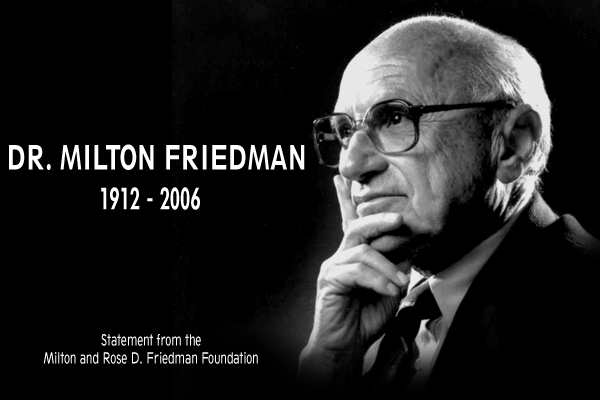
Milton Friedman was a giant of a man.
I first became aware of who he was in college, as my economics textbooks taught about his monetary policy views, which in the late 1970's were just beginning to win out over the generally accepted Keynesian view of monetary policy.
As a college junior, I transferred to study economics at University of Chicago, where Friedman taught and wrote. Although "Uncle Miltie" had just the year or so before left U of C for the Hoover Institution at Stanford, his shadow on the "Chicago School" was huge, as it remains today.
His list of truly world-changing ideas is phenomenal. There simply is no other economist who has had a more direct effect on the lives of Americans than Milton Friedman. His monetary theory was the intellectual basis for the Volcker Federal Reserve policies of the early 1980's that slew the inflation dragon and launched the U.S. on an unprecedented quarter century of growth.
He was the first to propose school choice. It was 1955 when he first wrote about how vouchers could improve a school system. In 1995 he started his foundation, which works to establish voucher and other school choice programs around the country. I have had the pleasure of working with his staff on various school choice issues.
In the 1980's he wrote the most popular book on economics ever written: "Free to Choose," in which he gave a layperson's intellectual argument for freedom. The book was the basis for a highly rated documentary that still is as fresh today as it was two decades ago.
This is only a small part of his list of professional accomplishments. On the personal side, I think he would tell you his biggest accomplishment is his 70 year love affair with his wife Rose, who is an accomplished economist in her own right. Rose Friedman grew up in Portland.
The world could use more people like Milton Friedman. Unfortunately, a talent like his is extremely rare. One of a kind.
Milton Friedman, a life well lived. We are all richer from it.
Subscribe to:
Posts (Atom)